-
Tel:15618093168
|
Email:2307176274@qq.com


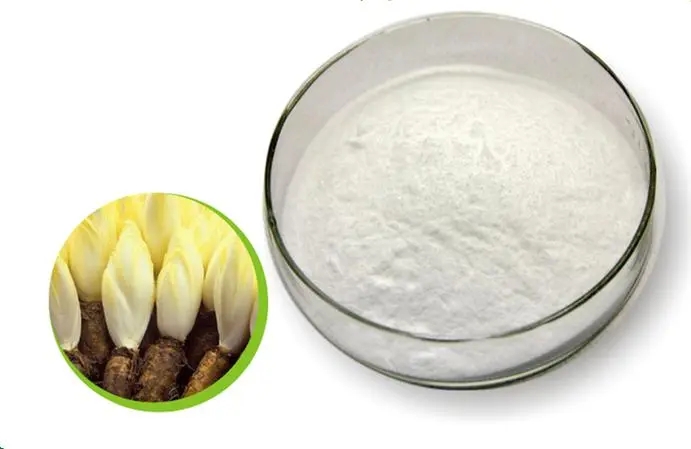
Inulin, as a reserve polysaccharide found in plants, exhibits several remarkable characteristics, which are mainly reflected in its source, chemical structure, physical properties, functions, and applications.
Inulin powder is primarily derived from plants, especially from dicotyledonous families such as Asteraceae, Campanulaceae, and Gentianaceae, as well as monocotyledonous families like Liliaceae and Poaceae. These plants convert solar energy into chemical energy through photosynthesis, storing it in the form of inulin.
Inulin is a linear, unbranched polysaccharide composed of 31 β-D-fructofuranose and 12 pyranose fructose residues, often with a terminal glucose residue. It has a degree of polymerization (DP) of 260. Inulin with an average DP ≤ 9 is referred to as short-chain inulin. This structure gives inulin its unique physicochemical properties and biological activity.
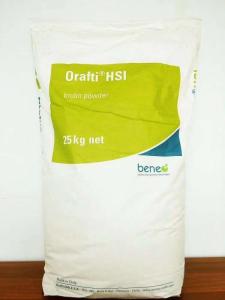
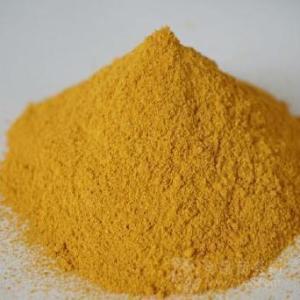
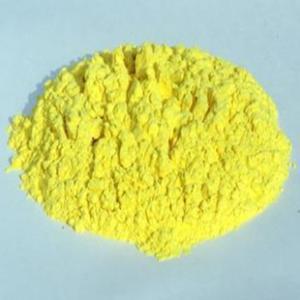
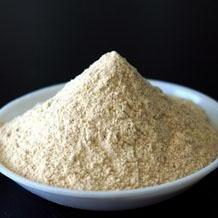
Dried inulin powder is a white, amorphous powder, sometimes with a slight yellow hue, and has a soft, fine texture. Its solubility increases significantly with temperature. For example, the solubility of regular inulin is around 6% at 10°C and can reach 33% at 90°C. Short-chain inulin is more soluble in water than long-chain inulin and contains more monosaccharides and disaccharides, giving it a sweetness approximately 30%-50% of sucrose. Regular inulin has a slight sweetness, about 10% of sucrose's sweetness, while long-chain inulin has almost no sweetness.
When the concentration of inulin solution reaches 10%-30%, it begins to form a gel. At concentrations of 40%-50%, a very firm gel can be formed. The viscosity of the gel decreases as the temperature increases.
Functions:
·Prebiotic Effects: Inulin can be fermented in the human colon, leading to an 8- to 10-fold increase in Bifidobacteria, thereby inhibiting the growth of harmful bacteria, improving the intestinal microecological environment, and promoting gut health.
·Lipid-lowering Effects: Inulin can reduce serum total cholesterol and low-density lipoprotein cholesterol levels, thus playing a role in lowering blood lipids.
·Blood Sugar Regulation: Since inulin is not hydrolyzed into monosaccharides in the intestine, it does not raise blood sugar levels or insulin content, helping to lower blood glucose levels.
·Immune System Boost: Inulin promotes the proliferation of beneficial intestinal bacteria and the production of metabolic products, which can activate intestinal lymphoid tissue and increase antibody secretion, thereby enhancing the body's immunity.
·Additional Benefits: Inulin also helps prevent constipation, improves skin condition, and promotes mineral absorption. For instance, it accelerates lipid breakdown and the production of basal cell peptides, promoting the proliferation of Bifidobacteria and the generation of short-chain fatty acids, thus helping to alleviate constipation symptoms.
Applications:
·Due to its unique physicochemical properties and biological activity, inulin powder has broad application prospects in the fields of food, health products, and medicine. In the food industry, it can be used as a functional food ingredient. In the health products sector, it is used to develop products that regulate gut microbiota, lower blood lipids and blood sugar. In the medical field, it can be used to treat conditions such as constipation and diabetes.
From the above description, it is evident that inulin possesses various significant features and functions, making it a natural polysaccharide with important application value.