-
Tel:15618093168
|
Email:2307176274@qq.com



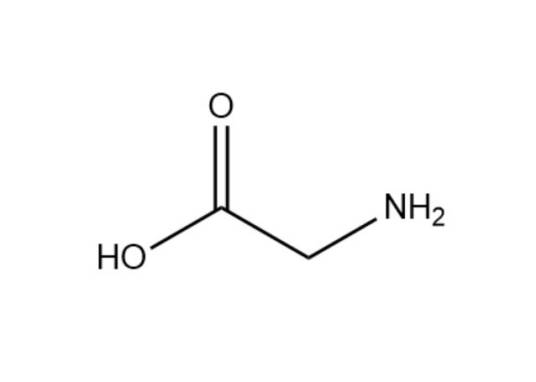
Glycine has a relatively simple structure, which can be represented by the structural formula H₂N-CH₂-COOH, or alternatively written as NH₂-CH₂-COOH, with the chemical formula C₂H₅NO₂. Below is a detailed analysis of glycine's structure:
I. Basic Composition
·Amino Group (-NH₂): Glycine contains an amino group, which is a common feature of amino acids and gives glycine its basic properties.
·Carboxyl Group (-COOH): Glycine also contains a carboxyl group, which is responsible for the acidic nature of glycine.
·Methylene Group (-CH₂-): Connecting the amino and carboxyl groups is a methylene group, which forms the simplest carbon chain part of the glycine molecule.
II. Structural Characteristics
·Simplicity: Glycine is the simplest amino acid in the amino acid series, with its side chain consisting of only a hydrogen atom, giving it high flexibility in protein structures.
·Polarity: Although glycine is overall polar (due to the presence of the amino and carboxyl groups), its side chain (R group) is just a hydrogen atom, leading it to be generally considered a non-polar amino acid. However, some viewpoints suggest that glycine’s side chain lies between polar and non-polar because its R group has little impact on the strongly polar amino and carboxyl groups.
·Solubility: Glycine is easily soluble in water, due to the hydrophilic nature of the amino and carboxyl groups. However, glycine is almost insoluble in non-polar solvents like ethanol or ether, reflecting the characteristics of its non-polar side chain.
III. Physicochemical Properties
·Melting and Boiling Points: Glycine has relatively high melting and boiling points, which contribute to its stability in various chemical reactions and physical processes.
·Ionization: In aqueous solution, glycine can ionize into cations and anions, carrying positive and negative charges, respectively. This allows glycine to participate in various ion reactions and charge transfer processes within biological systems.
IV. Biological Functions Glycine performs various important functions within the body, including protein construction, energy metabolism, and neurotransmitter synthesis. Its simple structure and unique physicochemical properties allow glycine to have wide applications and significant physiological roles in living organisms.
Glycine's structure, composed of an amino group, carboxyl group, and methylene group, features simplicity, polarity, and specific solubility. These characteristics enable glycine to play multiple essential functions in the body, making it one of the indispensable amino acids in living organisms.